I thought I understood effort.
Thirty-five years of coaching will do that to you.
Or at least, I thought it would.
After stepping away from Twin Falls, I wasn’t done coaching. I just didn’t want the size of it anymore. The pressure. The machine.
So I took a job at Lighthouse Christian School.
There were about thirty boys in the entire high school.
Thirty.
At a big school, you cut players.
At Lighthouse, you hope nobody discovers chess midseason and disappears.
The First Sign Things Were Different
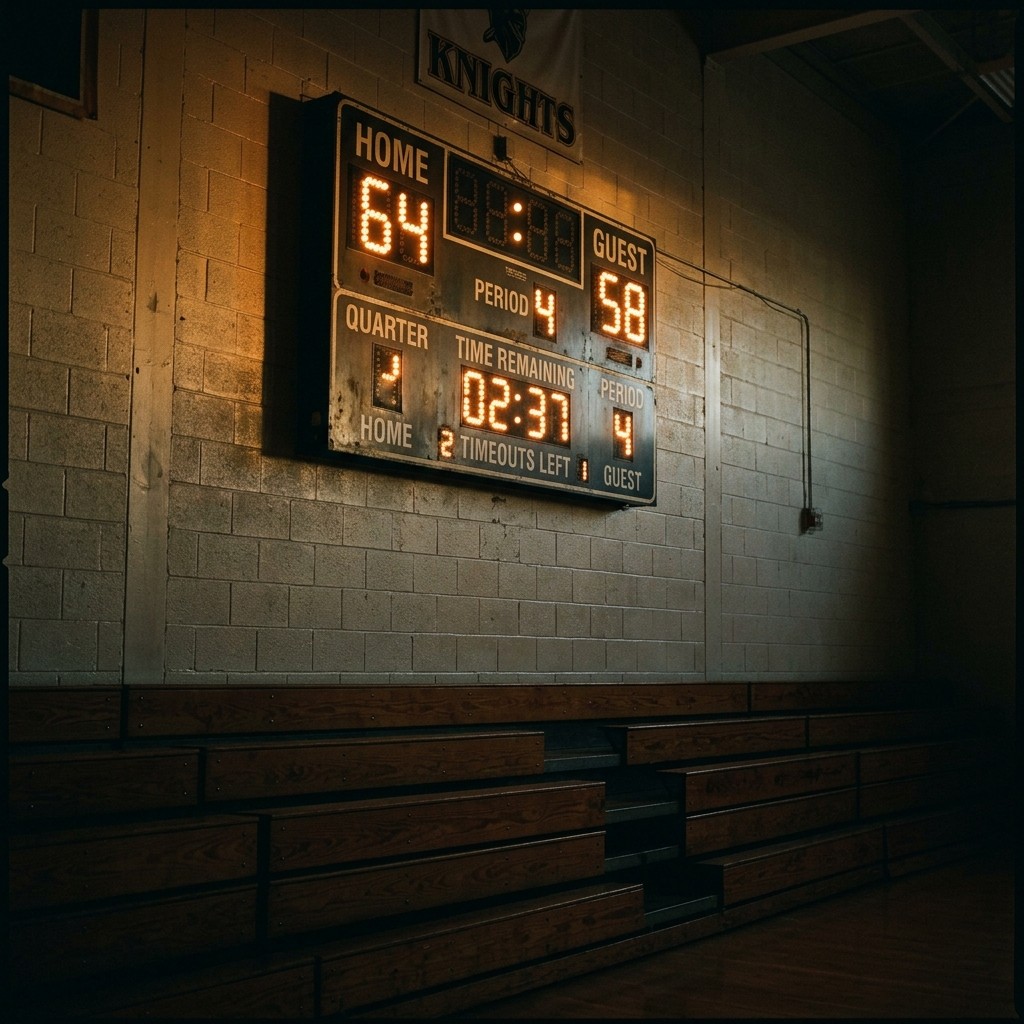
Someone, still anonymous to this day, decided it would be a great idea to mount the 35-second shot clock directly on top of the backboard.
Right above the rim.
If you’ve ever coached basketball, you already know where this is going.
That shot clock took an absolute beating.
Missed layups. Wild bank shots. What I can only describe as optimistic launches.
Every game I found myself thinking the same thing.
We are one possession away from losing the shot clock entirely.
I’m not sure it survived the season emotionally.
We Were Very Nice
The kids?
Great kids.
Respectful. Polite. Kind.
Almost aggressively nice.
Church-retreat nice, in the middle of varsity basketball.
Which led to one of my favorite moments of the season.
A player runs over during a game, leans in, and whispers:
“Coach, number 32 keeps pinching me.”
I just stared at him.
I’ve dealt with parents, principals, and administrators for thirty-five years. But I was not about to walk over to an official and say, “Excuse me, sir, number 32 is pinching us.”
That felt like paperwork I didn’t want to file.
So I leaned in and whispered back.
“Son, pinch him back.”
That was it.
No speech. No whiteboard. No team meeting.
Just a cultural adjustment.
That was our toughness seminar for the evening.
We Didn’t Even Know Which Way We Were Going Yet
Just when I thought I had a handle on how far we had to go, we had a loose ball scramble during a game.
Ball’s on the floor. Bodies everywhere. Pure chaos.
The other team finally picks it up, turns, and starts heading toward our basket.
And I’m thinking, great, easy two points.
Then one of our guys sprints in and fouls him.
Hard.
Whistle blows.
I look at him like, what are we doing?
And he looks right back at me and says:
“Coach, you said never give up an easy layup.”
I had to call timeout.
Not to draw up a play. To reset reality.
I said, “Guys, if they’re shooting at our basket, please let them score. Heaven knows we need the points.”
That’s when it really hit me.
They weren’t being lazy.
They weren’t being difficult.
They were trying.
They just didn’t know what trying was supposed to look like yet.
Then Came Tryouts
One kid walks in holding his IEP like he’s about to negotiate a contract.
Explains he’s allowed water breaks.
I said, “No problem.”
Five minutes into drills, he walks over and says, “Coach, I’m done.”
I said, “Alright, I appreciate you trying out.”
He looks confused.
“No, I’m just done for today. I’ll be back Monday.”
That’s when it hit me again.
We weren’t even speaking the same language yet.
The Vacation That Told Me Everything
And just when I thought I had a handle on things, districts rolled around.
Or almost rolled around.
Because we had players, and families, taking vacations right before the district tournament.
Not emergencies. Not once-in-a-lifetime trips.
Just vacations.
“Yeah coach, we’ll be back. Maybe.”
At that point I realized something.
This wasn’t about basketball.
The Part I Didn’t Want to Admit
For most of the season, I adjusted.
I explained more. Lowered expectations. Tried to meet them where they were.
If I’m being honest, I babied them.
And then one night, after another game where effort came and went like a bad radio signal, it clicked.
Not for them.
For me.
The Shift
I had been waiting for them to change.
Instead of changing what I allowed.
So we flipped it.
No big speech. No dramatic moment.
Just a shift.
- Effort became non-negotiable
- Competing became expected
- Standards became visible
We started watching film.
Not for plays. For effort.
Who sprinted. Who didn’t. Who competed. Who coasted.
And for the first time, they saw it.
What Happened Next
We didn’t suddenly become great.
The shot clock was still in danger most nights.
We still had moments that made zero sense.
But something changed.
They started working.
Not perfectly. Not consistently.
But noticeably.
What I Learned That I Should’ve Known
At big programs, effort feels automatic.
At smaller programs, it isn’t.
And sometimes the problem isn’t the players.
It’s what the coach is willing to tolerate.
Things don’t change when they’re ready. They change when you are.
Final Thought
That season wasn’t about wins.
It was about a realization.
For a while, I was allowing way too much.
Sometimes the wake-up call doesn’t come in a big moment.
Sometimes it comes from a kid reporting a pinch. A player done for the day at tryouts. A foul on the wrong basket. A missing player during districts.
And a shot clock barely hanging on for dear life.
If you stay in it long enough, you figure out the rest.
This is the other half of a story I started earlier — the season I found out they weren’t refusing to work hard, nobody had ever shown them how.
This story first appeared on Matt’s Substack. Read the original post — “Nobody Told Me This About Starting Over” — and subscribe to the newsletter for short stories and practical lessons like this one every week.